Tuesday, September 14, 2021

Peace Like That


I’m a metaphorical girl—I see connections everywhere. This year, I learned the word apophenia: the tendency to look for connections among unrelated things. I’m pretty sure I have a not-so-mild case of it. Whether through simile or metaphor, I am constantly comparing unlike things to better understand abstractions. 


In fact, here’s a metaphor: our marriage is a fascinating case of apophenia!


Which brings me to rivers. I spend A LOT of time on rivers since I married a man who loves them. And this spring, I’ve wondered about that metaphorical comparison of “peace like a river” in Scripture (Isaiah 48:18, 66:12).  Spend time on even a single river, and you realize that rivers are varied: once section might be placid as a pond. The next might be a white-water “boulder garden” your husband inexplicably wants to kayak through. 


Peace like which part of the river?


Like all of it. Like: peace in all the river sections, from frog water to Class V rapids. 


And peace in the snags—the fallen trees and root masses that accumulate along a shore. They can impede progress. But they can also create little eddies of stillness out of the fast current and give you a place to pause before you continue your journey. I kid you not, I had that snag realization by a river one morning, and that same afternoon, Jared and I got into a massive snag-fight. We got caught on the jagged edges of stuff we’d let accumulate along our shore, but once we pressed through, we found a pool of peace. Someday, we may even remember that there can be peace in the snags, too. 


I have an old hymn stuck on repeat in my heart: “When Peace, Like a River.” That song has always held power for me. It was originally titled, “It Is Well With My Soul” for its famous refrain: “It is well, it is well, with my soul.” But I didn’t learn why it was so powerful until last fall, when our friend came for dinner and played us the song on his guitar, telling the back story. 


Horatio G. Spafford wrote the hymn in the nineteenth century. He was a prosperous businessman in Chicago. He and his wife had a son and four daughters. Things were going well—until they weren’t. They lost their son to scarlet fever. Then, the Great Chicago Fire destroyed all of Horatio’s real estate, wiping out his life savings. He decided to take his family to England to try and start over. Right before he planned to leave, a business deal arose that could help his family, so he decided to send his wife ahead of him with their daughters. 


The boat carrying his family shipwrecked. His wife survived, but all of their daughters died. As soon as he received the news, Horatio took the next ship to be with his wife. At one point on the voyage, the captain told him they had reached the spot where his children had drown. And there—in the place of deep loss and sorrow—he wrote a hymn of peace. Here are the first lines:


When peace like a river, attendeth my way,

When sorrows like sea billows roll;

Whatever my lot, Thou hast taught me to know

It is well, it is well, with my soul.


Refrain

It is well, (it is well),

With my soul, (with my soul)

It is well, it is well, with my soul.


That man’s understanding of grace takes my breath away. It makes me game to learn the currents of peace like a river. 


I want peace like that. 


Wednesday, August 25, 2021

Flower it Forward


The thoughtful Del Rio Vineyards offers our little valley a big gift: rows of U-pick zinnias below their hillsides of vines. 

The only catch? For each bouquet you pick for yourself, you pick two for others. "Flower it forward." 

I like this double-happiness approach to "pay it forward." Not just singly, but doubly. 

Thank you, Del Rio, for reminding us to give more than we get. I'm excited to deliver these bright gifts. 


Tuesday, July 27, 2021

All of the Above


On one of the rare weekends this summer we weren’t camping, my husband and I attended our church’s outdoor service. We sat beneath an umbrella on a beautiful morning, the sky broad above us. Our friend, Niesje was leading worship. Before beginning a song about bringing Heaven to Earth, she reminded the congregation that, with God, anything can happen. 

God often speaks to me in wordplay (I like to call Him the Wordsmith). As Niesje spoke, I heard in my heart the phrase “all of the above.” Such words and phrases usually arrive simultaneously with layers of meaning, and it can take me a moment to unfurl them. One layer to “all of the above” was Heaven, as in: all of what is higher, all of what is possible. At that moment, beneath the expansive sky, I was reminded of the vastness of possibility. 


But “all of the above” also referred to that pesky option on multiple-choice tests. 


I was never a good test taker. I could study, and I did—hard. But because I didn’t have the knack of knowing what test makers expected, I spent way too much time trying to memorize things instead of learning their context and how they worked together. 


When required to answer essay questions, I could “show” my work and explain nuances, which helped. But for multiple choice tests, there is just one right answer. Pretty black and white. Unless there is the shades-of-gray option D: All of the above. 


In school, I loved and hated “all of the above.” It meant there was more than one correct answer (which I secretly believed about most everything). But it also meant I’d have to know the subject well enough to know that A, B, and C were all correct, too. 


That Sunday beneath the Heavens, I recognized that I’d been slipping back into old patterns of limited, either/or thinking—of believing I’d have to choose just A, B, or C. I was reminded that God is big enough to be both/and—even big enough to offer an alphabet-length set of options and for all of them to be possible! He is big enough to offer all of the above.


I was recently reading about dialectics, which is basically a fancy way to say “both/and” thinking. It’s the paradox of seemingly contradictory things being true, like feeling sad and hopeful at the same time. In other words, there is usually more than one “correct” answer—or at least more than one way to arrive at it. 


Life will throw tests at us—both essay and multiple choice. But it helps to remember that God offers more answers than any test key. It also helps to remember that He is not sitting around in Heaven with a big red pen, waiting to tally our mistakes and write a low score across our lives. In fact, I have a feeling God isn’t really into tests. Humans? For some reason, we seem to like them. So here’s a test on subject matter I’m trying not to memorize but to learn, to embody: 


A. God is not a test maker, waiting to fail us


B. God is love, and love is BIG: bigger than our closed either/or thinking and bigger than our most open and noble imaginings


C. He invites us to dream with Him and Heaven—to get to know Him well and to embrace the mystery of what we do not know


D. All of the above


Wednesday, June 30, 2021

Brief Beauty


So brief, these.

So long from seed to blossom

then so quick to drop their petals.

But worth the pink while.


Thursday, May 27, 2021

Of literature & Landscaping


I am being lazy on the literary front by not writing something fresh for this post, but all my spring creativity has been going toward landscaping!

So for this month, I'll just say: I am delighted to have won an Oregon Book Award for my poetry collection, Hope of Stones. It was far more rewarding than making my own mulch! Immense gratitude to everyone at Literary Arts for honoring these poems and to dear Press 53 for publishing them. 

Here's to words and wheelbarrows and wonder,

Anna 

Friday, April 30, 2021

The Poet Wonders

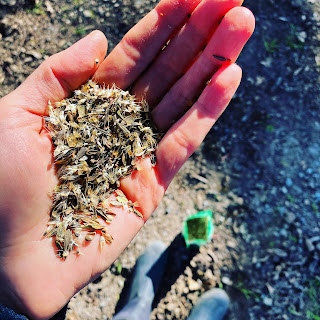
Nationally, it has been poetry month, but personally, it has been gardening month (with plenty of gravel schlepping!). In the realm of poetry, my collection Hope of Stones was nominated as a finalist for the Oregon Book Awards. I wait to hear the results. In the realm of gardening, I planted seeds. I wait to see the results. 


I’ve always honored the timeless metaphor of a garden, but it’s one thing to write about it. It’s another to prepare the soil and plant the physical seeds. 


Since I’ve spent far more time with a shovel than a pen this month, I thought I’d pull out a poem from Hope of Stones. Unlike the opening line, it is still the “month of April & maybes.” So much waiting. And even more than the results of the book awards, I am excited to see what this coming harvest season will bring. 


The Poet Wonders

Oregon, October


The more I wonder, the more I love.—Alice Walker


It is no longer the month of April & maybes. 

It’s October & root vegetables—the soil-

pulled concretions of harvest. What we seeded 

in spring has grown up & down & waits 

for us to lift it from the skin of earth. 


How silent prayer was revelation & heresy.


The clouds roll in. The leaves redden. 

The cat’s coat thickens. We gather 

the tangible close & prepare for cold. 


How physics is the science of prayer.


One friend is dying. Another is trying to love 

someone who doesn’t love her back. 


I visit the first friend, & we sit on his deck 

watching tractors in the adjacent forest dig 

foundations for new houses he will never see. 


I visit the other friend & notice the old 

potatoes she keeps on a shelf. They’ve 

shriveled a bit but have new eyes—new shoots 

already looking for somewhere else to grow.  


How a perennial can inspire prayer.


Tuesday, March 30, 2021

The Personality of Process: On the Enneagram, the house we built, and marriage

The house foundations last August

Blobs, spots, specks, smudges, cracks, defects, mistakes, accidents, exceptions, and irregularities are the windows to other worlds.—Bob Miller


Part One: In Which I Vent About the Enneagram (Though I Love It, Too)


If you know a bit about the Enneagram, you know that you are likely one of nine types—and that each type has specific fears and desires and motivations. Learning about this framework helps us understand ourselves and others. 


However…I’ve also learned that you can come into this world as one type but can learn to adapt into another type that appears to serve you or others better. And then you can be very confused.


There are various schools of the Enneagram, and many of the types have different names according to which one you study. I believe I came into this world a Four—the Romantic or Individualist. But the world rewarded my ability to be a One: the Perfectionist or Reformer. I joke that I’m either a Perfecting Romantic or Romanic Perfectionist.


From my school years through the first months of my marriage, I lived pretty well as a Perfectionist-Reformer One. Even my creativity was highly structured; I’d embark on a series of 100 portraits, 30 days of painting-poems, et cetera, et-orderly-cetera. It didn’t help that most organized religion and education love achievers—and boy could I achieve. In grade school, I memorized whole chapters of Corinthians for our church version of the Girl Scouts, The Missionettes. (Somewhere, there exists a photo of myself wearing a turquoise polyester sash with all of my badges). I worked to be high school valedictorian. Then I worked even harder to be undergraduate summa cum laude. By grad school, I let myself breathe and settled for magna cum laude. And that was probably because, while I shaped my poetry thesis, I rediscovered a wild creativity longing to play free—uncaged by a rigid grid of quantification.   


And then, decades later, I got married. Funny thing about marriage: your True Self emerges in a way it never did before. True union eventually squeezes out anything false. And when two become one, a lot of shit has got to go. (I could make a terrible pun here about two each becoming the most annoying parts of the Enneagram’s Reformer One, but I shall not!) 


Suffice it to say, that whatever façade we’ve built basically gets shaken off, and whatever’s underneath probably has some black mold and maybe a rat or two, despite however many years we think we’ve done our spirit excavation. 


And also, I married an Eight: the Challenger. Challengers can call your bluff pretty darn well. 


Part Two: In Which I Vent About Building a House (Though I Love It, Too)


This all leads me, most indirectly, to the process of building a house—before we’d been married a year. (In fact, as I write this, we are just about to reach our nine-month anniversary). 


But before I get to that, I should also mention that it took me until my forties to see an obvious life pattern. During my college years, I worked as a housecleaner—for residential and professional buildings. And then I worked as an editor in some capacity for longer than most starting editors have been alive. Cleaning and editing. Basically, I trained myself to see the mess and the misspelled and to perfect them all. But such tasks, though they felt good when done, didn’t feel good in the process; they felt exhausting and never-ending. I wouldn’t so much celebrate as check off the completion of each round of “perfecting,” even as I braced myself for the next round of trash and typos. Versus celebrating the process—mud ‘n’ all. 


And let’s just say that pointing out all the dirt and dialogue flaws is not a beneficial marriage skill. But the long-entrenched One in me—the Perfectionist-Reformer—was so used to doing this, that it was hard to stop. It took me a while to be grateful for the fact that my husband doesn’t really care if things are clean or if every T is crossed. “But these are my strengths!” a part of me kept shouting. 


Meanwhile, behind the scenes, the truer part of myself kept saying she loved going off on muddy river adventures and not needing to analyze the etymology of the kayak term “boof.” 


One book on the Enneagram is called The Road Back to You. The One-Me never understood that title. The Four-Me is jumping up and down for childlike joy, saying, “Yes! We’re back!”


Marriage has invited me to return to my creative being: my True Self, the Self who loves paint splatters and rough-edged canvas and impromptu word play for pure fun; the Four who knows that all of life is poetry, not just words on a page—or a specific page count. That Self has risen up alongside our house.


Yes, finally, I get to the house. It has become my metaphor for building a more authentic self and marriage. 


Last summer, I took a photo of the foundations—surrounded by heaps of displaced earth. Where wild grass had grown in beautiful abandon, the hillside looked like a jagged scar. But we wanted to build something, and so we had to tear into what was there. We had to make a mess.


Now, a brick home stands on that site, finished, after months of trucks and lumber. But nothing is ever finished, is it? The wake of construction rubble and ruts surrounding the house remind me how ongoing building really is.


Our first day in the house

So that Miller quote I opened with; I am still struggling to love the messy process. But now that I’ve been building a life with someone and building a house with someone—I am beginning to get it. 


I am also beginning to embrace both the Reformer and the Romantic in myself—and I consciously choose those two labels for the One and the Four. The drive for excellence in the former helped ground the often formless creative sensitivities of the latter. Maybe I’ll call myself a Romantic Reformer—head in the clouds but feet on the ground. Imperfectly trying to bring Heaven to Earth.


The two types in me have finally become one.


Union starts in our very own hearts. 


Part Three: In Which I Don’t Vent About Marriage, But Instead Write A Poem About It


O this strange bliss—

brimming with

mess & misspellings 

mud & wonder—

I embrace all 

your stains & stars.


Two become 

one house 

uniting 

divided hearts


We build

a mystery.


Right after the land became ours last spring